
![【日本唯一 徳島】水銀朱の採掘遺跡『若杉山辰砂採掘遺跡』 – [Tokushima] Mercury vermillion mining site “Wakasugiyama Cinnabar Mining Site” | 物語を届けるしごと](https://yousakana.jp/wp-content/uploads/wordpress-popular-posts/42801-featured-120x120.jpg)
![【香川】川沿いをピンクに彩る80本の桜。湊川『河津桜ロード』 - [Kagawa] Kawazu Cherry Blossom Road](https://yousakana.jp/wp-content/uploads/wordpress-popular-posts/49092-featured-120x120.jpeg)


![【香川】春日川の川市 – [Kagawa] River market of Kasuga river](https://yousakana.jp/wp-content/uploads/wordpress-popular-posts/49605-featured-120x120.jpeg)


![【香川】父母ヶ浜が一望!絶景で食べる絶品ハンバーガー『BAKE STUDIO OKAZAKI』- [Kagawa] Hamburger shop at Chichibugahama beach](https://yousakana.jp/wp-content/uploads/2021/06/BAKE-STUDIO-OKAZAKI-800x534.jpg)
![【国指定史跡】高松の古墳の特徴はキャンディー型『石清尾山古墳群』 – [National Historic Site] Iwaseoyama kofun Tumulus Cluster](https://yousakana.jp/wp-content/uploads/2020/07/iwaseo-kofun-1-800x533.jpg)
![【香川】桃太郎伝説の残る『鬼ヶ塚』の桜 – [Kagaawa] Cherry blossoms at Onigazuka, where the legend of Momotaro remains.](https://yousakana.jp/wp-content/uploads/2023/03/panorama_sakura_kinashi-800x533.jpg)
![【小豆島 3/29-5/10】瀬戸内海を泳ぐ鯉のぼり『旧戸形小学校』 – [Shodoshima island 3/29-5/10]Carp streamers in the Seto Inland Sea. ‘Former Togata Primary School’](https://yousakana.jp/wp-content/uploads/2022/05/Carp-streamers_Togata-Primary-School-800x534.jpeg)
![【愛媛 10/20】お供馬の走り込み「菊間祭り」 – [Ehime 20 Oct.] Kikuma Otomouma festival](https://yousakana.jp/wp-content/uploads/2018/08/otomouma-800x533.jpg)
![【香川】美術館は心の病院『丸亀市猪熊弦一郎現代美術館』 – [Kagawa] Art is a Vitamin “MIMOCA”](https://yousakana.jp/wp-content/uploads/2023/12/mimoca_01.jpeg)
![【香川】四国霊場第81番札所、白峰寺 – [Kagawa] Shiromineji temple](https://yousakana.jp/wp-content/uploads/2021/11/shiromineji-temple_kagawa_sakaide-800x534.jpeg)
![【香川】焼菓子工房 ボンボニエール – [Kagawa] Baked Confectionery Bonbonniere](https://yousakana.jp/wp-content/uploads/2021/05/bonbonniere_title-800x533.jpg)
![【香川 10/12-2/2 生誕120年!!】香川をデザインした男、和田邦坊「灸まん美術館」 – [Kagawa 12th Oct. – 2nd Feb. ] Works of Kunibo Wada, 120th Anniversary](https://yousakana.jp/wp-content/uploads/2019/08/kunibo-wada_kyuman-museum-800x407.jpg)
![【徳島】果樹園がつくる20種類以上の無添加シロップ『川添フルーツ』 – [Tokushima] Kawazoe Fruit](https://yousakana.jp/wp-content/uploads/2021/02/kawazoe-fruit_tokushima_small-800x533.jpg)
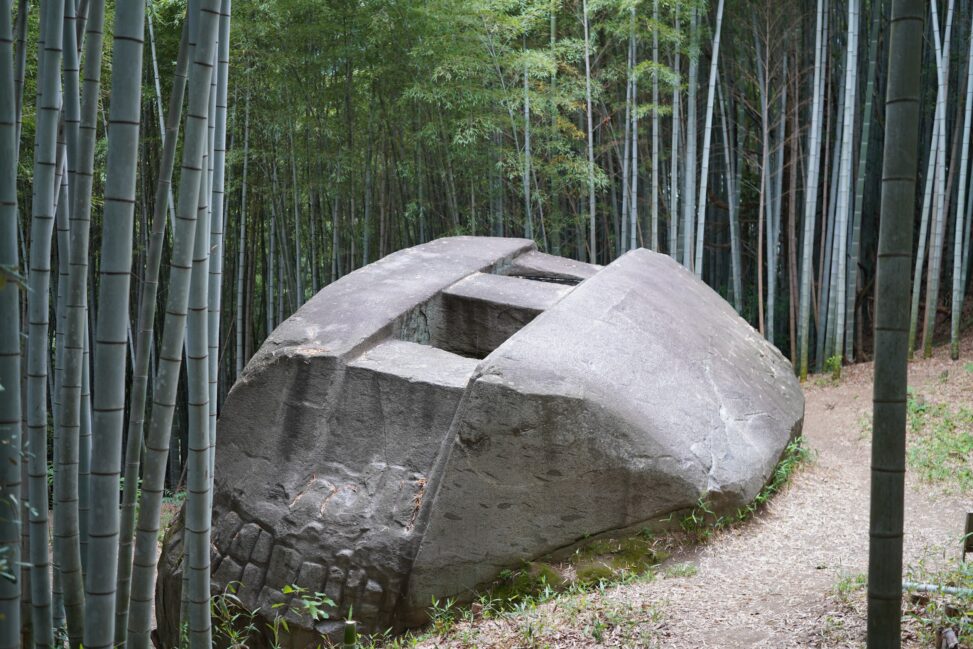
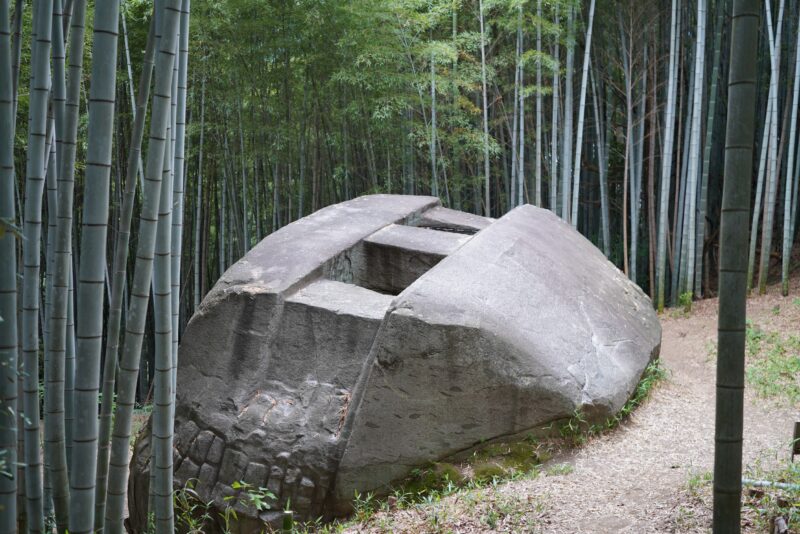
益田岩船(ますだのいわふね)は、奈良県橿原市(かしはらし)白橿町(しらかしちょう)の丘陵上に残る、飛鳥時代を代表する巨大な石造物です。東西約11メートル、南北約8メートル、高さ約4.7メートルにも及び、亀石や酒船石などと並ぶ飛鳥の石造物の中でも最大級を誇ります。硬質な石英閃緑岩を精巧に削り出した台形状の巨石で、上部には溝と二つの方形穴が穿たれています。
築造時期や用途を示す文献は残っておらず、目的は謎に包まれています。益田池を讃える石碑の台座説をはじめ、天体観測台、火葬墓、物見台など諸説がありますが、現在では未完成の横口式石槨(よこぐちしきせっかく / 古墳石室)であったとする説が有力です。加工途中で破損が見つかり、放棄された可能性も指摘されています。
1976年(昭和51年)に奈良県指定史跡となり、竹林に囲まれた静かな山中に、そのミステリアスな姿を今に伝えています。誰が、何のために造ったのか――飛鳥の石文化と古代技術の奥深さを感じさせる遺跡です。
Masuda Iwa-fune is a colossal stone structure representing the Asuka period, remaining atop the hills in Shirakashi-chō, Kashihara City, Nara Prefecture. Measuring approximately 11 metres east-west, 8 metres north-south, and standing about 4.7 metres tall, it ranks among the largest stone structures of Asuka, alongside the Kameishi and Sakabuneishi stones. This massive, trapezoidal boulder is meticulously carved from hard quartz diorite, featuring a groove and two square holes at its summit.
No written records indicating its construction period or purpose survive, leaving its function shrouded in mystery. Theories range from a pedestal for a stone monument honouring Masuda Pond, to an astronomical observatory, a cremation tomb, or a lookout platform. The prevailing theory today suggests it was an unfinished horizontal-opening stone chamber tomb (an ancient burial chamber). It has also been suggested that damage discovered during its construction may have led to its abandonment.
Designated a Nara Prefecture Historic Site in 1976 (Showa 51), it retains its mysterious appearance today, nestled in the quiet mountains surrounded by bamboo groves. Who built it, and for what purpose? This site evokes the profound depth of Asuka’s stone culture and ancient technology.
2025/05/31撮影

石英閃緑岩を削り出した台形状の巨石

石室の穴が空いています。穴を開けた後、全体を横に倒して使う予定だったと考えられています。


解説板。

史跡 岩船
貝吹山の連峰である石船山の頂上近くに所在する花崗岩製の巨大な石造物で、俗に「益田岩船(ますだのいわふね)」と呼ばれている。
この石造物は、東西約11m、南北約8m、高さ(北側面)約4.7mの台形を呈し、頂上部および東西両側面に、幅約1.8m、深さ約0.4mの浅い溝状の切り込みが設けられている。頂上部では、この溝内にさらに約1.4mの間隔をおいて、東西に二つの方形の孔が穿たれている。孔は東西1.6m、南北1.6m、深さ1.3mと東西ほぼ等しく、孔の底部周囲には幅約6cmの浅い溝が巡らされている。 石の加工は上半部が平滑に仕上げられている一方、下半部は荒削りのままで、格子状の整形痕が認められる。
古くから、この地に築造された益田池の台石とする説があるほか、頂部の平坦面を九十度回転させた横口式石槨とする説、占星台の基礎とする説、あるいは物見台とする説などが唱えられてきた。
このように用途は明らかではないものの、上部平坦面の溝や孔が高麗尺で計画されていることや、花崗岩の加工技術が終末期古墳と共通する点などから、少なくとも七世紀代の特色を備えており、飛鳥地方に分布する特異な石造物の中でも最大級のものといえる。
橿原市教育委員会
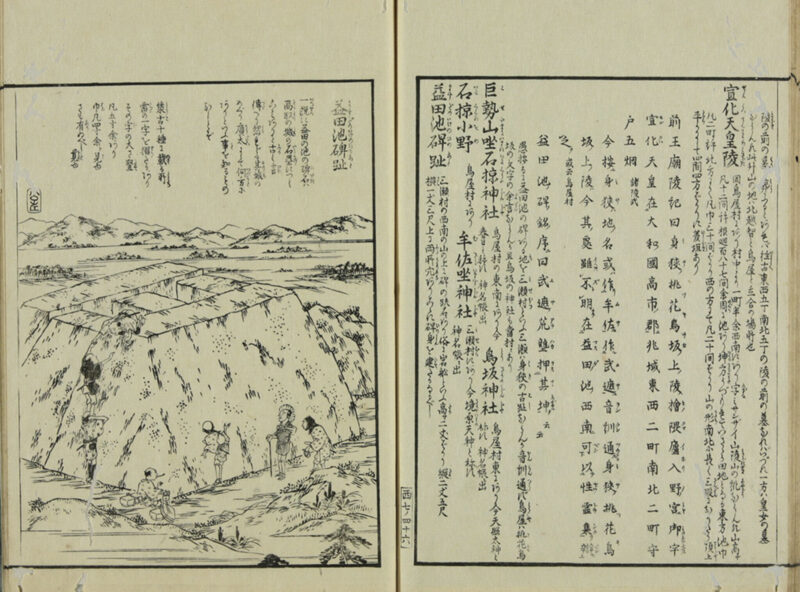
「西国三十三所名所圖會」早稲田大学図書館所蔵より。
近年、有力とされているのが、南東約500メートルに位置する斉明天皇陵とされる牽牛子塚古墳との関係です。牽牛子塚古墳の横口式石槨は、巨大な切石を精密に加工した構造をもち、益田岩船の方形穴の形状や寸法とよく似ています。このことから、益田岩船は斉明天皇の古墳石室を造るために試作、あるいは前段階として切り出されたものの、石材の破損などにより未完成のまま放棄されたのではないか、という説が提唱されています。
誰が、何の目的で造り、なぜ完成しなかったのか――その答えはいまも明らかではありません。竹林に囲まれ、静かに横たわる益田岩船は、飛鳥時代の国家的事業や高度な石工技術、そして未完に終わった歴史の一端を、現代に伝える謎多き遺構です。
In recent years, a prominent theory concerns the relationship with the Kengyūshi-zuka Kofun, believed to be the tomb of Empress Saimei, located approximately 500 metres to the southeast. The lateral-entrance stone chamber of the Kengyūshi-zuka Kofun features a structure of precisely worked massive cut stones, closely resembling the shape and dimensions of the square cavity at Masuda Iwafune. This has led to the proposed theory that the Masuda Iwakubo may have been quarried as a trial or preliminary stage for constructing the stone chamber of Empress Saimei’s tomb, only to be abandoned unfinished due to damage to the stone materials or other reasons.
Who built it, for what purpose, and why was it never completed? The answers remain unclear to this day. Surrounded by bamboo groves and lying quietly, the Masuda Iwakubo is an enigmatic structure that conveys to the present day a glimpse of the national projects and advanced stonemasonry techniques of the Asuka period, and a fragment of history left unfinished.
こちらは、斉明天皇の陵(みささぎ)。牽牛子塚古墳(けんごしづかこふん)(明日香村)

八角形。別名「朝顔(アサガオ)古墳」


解説板


模型

石室

牽牛子塚古墳・越塚御門古墳 復元公開|奈良県観光[公式サイト] あをによし なら旅ネット|明日香村
古代天皇家墳墓の象徴である「八角形」の墳丘が復元され、現代によみがえりました。飛鳥時代、史上初めて2度天皇となった皇極・斉明女帝。彼女が娘と孫娘と一緒に眠る古墳が、牽牛子塚古墳・越塚御門古墳です。今回、古代天皇家墳墓の象徴である「八角形」の墳丘が復元され、現代によみがえりました。「あさがお塚」とも呼ばれるこの美しい古墳をぜひ訪れてみてください。
More from my site
- コカ・コーラのボトルの形
- 小豆島 中山地区の棚田を元気にする地域おこし協力隊員を募集しています。 #小豆島
 トルコ・ランプ – turkish lamp
- 【離島経済新聞×せとうち暮らし】 離島経済新聞で瀬戸内の島々のコラムはじまります。『せとうち暮らし』編集部ノート @ritokei @setokurashi
 瀬戸内生活工芸祭2014 Setouchi Craft Festival 2014
- パトリシア・ウルキオラ – Patricia Urquiola Design Museum London
- 瀬戸内5県が広域観光組織、「瀬戸内ブランド推進協議会」を発足したそうです。 #setoch
![【閉店】多くの芸術家が愛した讃岐料理「まいまい亭」 – [Closed] Maimai-tei, rendezvous for artists](https://yousakana.jp/wp-content/uploads/2018/12/hirarani-isamu-noguchi-150x150.jpg) 【閉店】多くの芸術家が愛した讃岐料理「まいまい亭」 – [Closed] Maimai-tei, rendezvous for artists
【閉店】多くの芸術家が愛した讃岐料理「まいまい亭」 – [Closed] Maimai-tei, rendezvous for artists- 100万人のキャンドルナイト
 【香川 秋冬営業】まるで宝石。山奥にぽつんと佇む甘納豆専門店『村瀬食品』 – Ama natto (sugared red beans) “Murase Foods”
コメントを残す