


![【香川】サンポート高松に外資系ホテルが開業予定 – [Kagawa] New hotel will open in Sunport Takamatsu](https://yousakana.jp/wp-content/uploads/2022/06/sunport-takamatsu_hotel-800x533.jpeg)
![【愛媛】犬寄峠の黄色い丘 – [Ehime] The Yellow Hill at Inuyose Pass](https://yousakana.jp/wp-content/uploads/2026/04/TheYellowHill_InuyosePass-1-800x534.jpg)
![【香川】青峰山 千手院「根香寺(ねごろじ)」の紅葉 – [Kagawa] Autumn leaves of Negoroji temple](https://yousakana.jp/wp-content/uploads/2020/11/Autumn-leaves-of-Negoroji-temple-800x534.jpg)



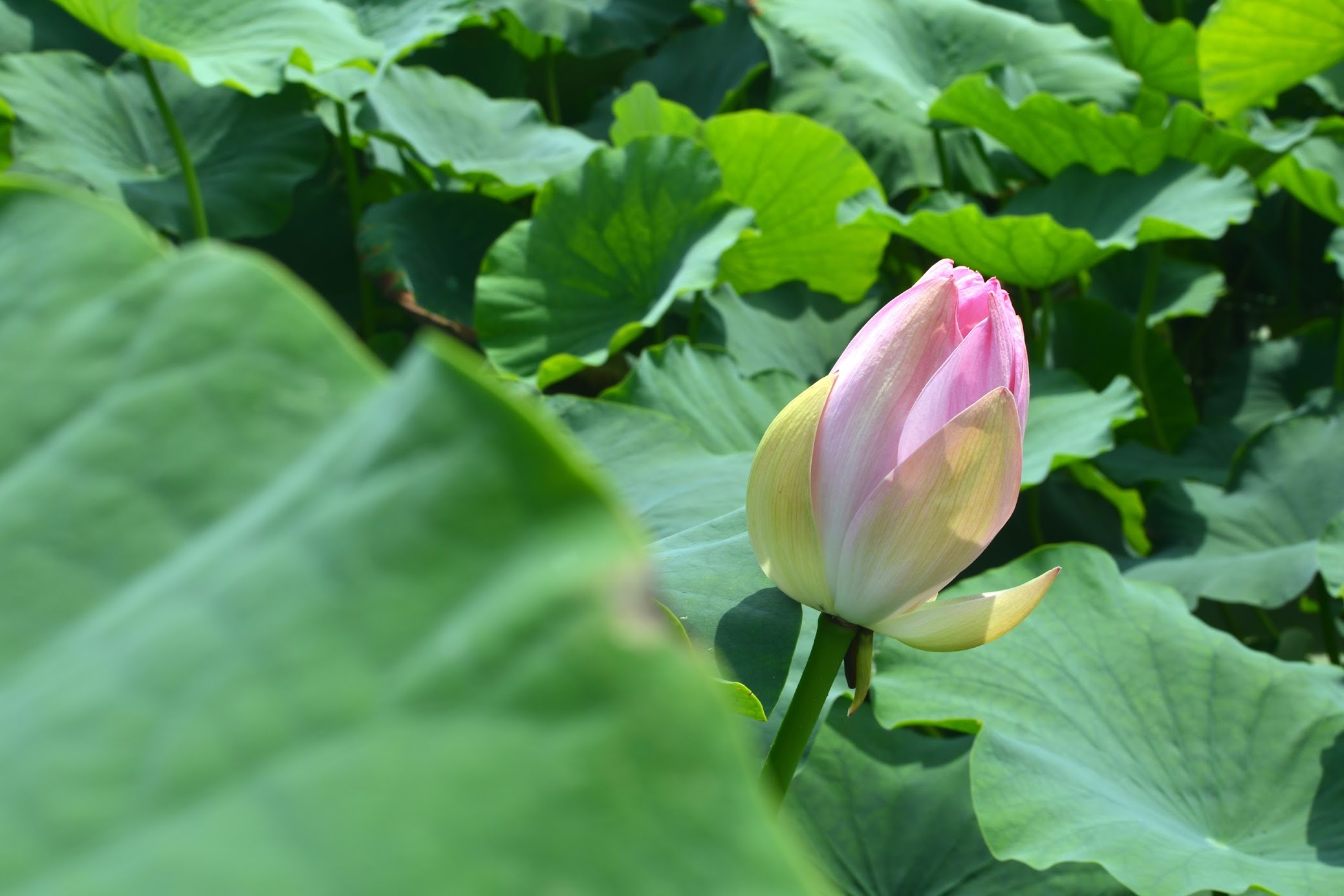
見渡す限り広がるレンコン畑。徳島県は全国第2位の出荷量を誇るレンコンの生産地です。鳴門市から松茂町あたりはレンコンの産地で、夏になると大きな緑色の葉が重なりあう壮大な景色が広がっています。
You can see the lotus land as far as you can see at Tokushima pre., Japan. Tokushima pref. is the 2nd largest producer of lotus roots in Japan. Naruto city and Matsushige town are the production area of lotus. You can meet magnificent scenery.
2016/07/01撮影


徳島のレンコン――吉野川が育てた、泥の中の恵み
Tokushima’s Lotus Roots – A Gift from the Mud, Nurtured by the Yoshino River
徳島のレンコン産地を訪れると、広い水田のような畑に、レンコンの葉が一面に広がっている。主な産地は鳴門市から松茂町、北島町、藍住町など、吉野川下流域に位置する。この風景を見ていると、なぜ徳島でレンコンが盛んに作られているのか、その答えは作物ではなく、まず「土地」にあることに気づく。
吉野川は、四国山地から大量の土砂を運び、長い時間をかけて下流に広大な沖積平野をつくってきた。現在の吉野川だけでなく、旧吉野川や今切川などが複雑に流れるこの地域は、もともと水と土砂が集まる低湿地だった。細かな土砂が堆積した粘土質の土壌と豊かな水は、水を張った状態で育つレンコンに適している。
しかし、徳島のレンコン産地は、最初からレンコンのためにつくられたわけではない。吉野川河口に近い地域では、海水の影響を受けやすく、かつては塩害が農業の大きな問題だった。そこで、水稲だけに頼らない農業を模索するなか、大正時代に岡山から種レンコンが持ち込まれた。1918(大正7)年ごろから始まった栽培は、やがて大津町などへ広がり、戦後の農業政策や水田転作を背景に、本格的な産地へと発展していった。
つまり徳島のレンコンは、「吉野川がつくった湿地」と「塩害という土地の弱点」を、農家が別の価値へと変えた作物ともいえる。レンコンの品質を支えるのも、この土地の土である。吉野川下流域の粘土質の土壌のなかで地下茎を伸ばすことで、身が締まり、歯切れのよい食感が生まれる。徳島、とりわけ大津地区では「備中種」が主要品種として栽培され、白くきめ細かな肉質とシャキシャキした食感が特徴とされる。
さらに、レンコンは土の中にあるため、収穫にも技術が必要になる。粘りの強い土を一つひとつ掘り起こし、地下茎を傷つけないように取り出す「鍬掘り」は、機械化が難しい一方、レンコンの姿を美しく保つ伝統的な技術である。収穫前の葉刈りなど、白さや品質を保つための細かな工夫も積み重ねられてきた。こうして育てられたレンコンは、徳島県内だけでなく、鳴門海峡を越えて京阪神へと運ばれていく。徳島は古くから畿内との交流が盛んな土地であり、農産物の流通においても大阪市場との結びつきが強かった。都市近郊のレンコン産地が減少するなかで、徳島の産地はその需要を支える重要な供給地となっていった。
そしてレンコンは、単なる農産物を超えて、日本の食文化にも深く入り込んでいる。穴の開いたレンコンは、「先が見通せる」とされ、正月のおせち料理に欠かせない縁起物となった。徳島でも年末に出荷の最盛期を迎え、吉野川下流の水田地帯で育ったレンコンが、正月の食卓へ届けられる。
そこには、徳島の土地の歴史が凝縮されている。山から流れ出た水が吉野川となり、土砂を運ぶ。土砂が低地をつくり、低地に水がたまる。その土地が水田となり、塩害を経験し、レンコン田へと変わる。農家が品種と栽培技術を磨き、京阪神という市場と結びつく。そして、その収穫物が正月の食卓を彩る。
さらに現在、レンコン田は農業生産の場であるだけでなく、水生生物や水鳥などの生息環境としても重要な役割を果たしている。吉野川下流のレンコン畑は、人間が湿地を農地として利用することで生まれた「農の湿地」ともいえる。徳島のレンコンを見ることは、野菜を見ることではない。吉野川の地形と水、沖積層の土、海との距離、農業の歴史、農家の技術、都市との流通、そして正月の食文化。それらが一本の地下茎のなかにつながっている。徳島のレンコンとは、まさに吉野川がつくった土地を、人が耕し、食文化へと変えてきた「土地の味」なのである。
When you visit the lotus root-growing regions of Tokushima, you will see fields resembling vast rice paddies, completely covered with lotus leaves. The main production areas are situated in the lower reaches of the Yoshino River, stretching from Naruto City to Matsushige Town, Kitajima Town and Aizumi Town. Looking at this landscape, one realises that the answer to why lotus root cultivation thrives in Tokushima lies not in the crop itself, but first and foremost in the ‘land’.
The Yoshino River has carried vast quantities of sediment from the Shikoku Mountains, gradually forming a vast alluvial plain downstream over a long period of time. This region, through which not only the present-day Yoshino River but also the former Yoshino River and the Imakiri River flow in a complex network, was originally a low-lying wetland where water and sediment accumulated. The clay-rich soil, formed by the accumulation of fine sediment, combined with an abundance of water, is ideal for lotus roots, which thrive in waterlogged conditions.
However, Tokushima’s lotus root-growing areas were not created specifically for this crop from the outset. In regions close to the mouth of the Yoshino River, where the area is susceptible to the influence of seawater, salt damage was once a major problem for agriculture. Consequently, whilst seeking to diversify away from a reliance on rice cultivation alone, lotus root seeds were introduced from Okayama during the Taishō era. Cultivation, which began around 1918 (Taishō 7), eventually spread to areas such as Ōtsu Town and, against the backdrop of post-war agricultural policies and the conversion of paddy fields to other crops, developed into a fully-fledged production area.
In short, Tokushima’s lotus root can be described as a crop through which farmers transformed the ‘wetlands created by the Yoshino River’ and ‘the land’s vulnerability to salt damage’ into something of value. It is also the soil of this region that underpins the quality of the lotus roots. As the rhizomes grow in the clay-rich soil of the lower reaches of the Yoshino River, the flesh becomes firm, resulting in a crisp, satisfying texture. In Tokushima, and particularly in the Otsu area, the ‘Bichū’ variety is cultivated as the main type, characterised by its white, fine-grained flesh and crisp texture.
Furthermore, as lotus roots grow underground, harvesting them requires a certain level of skill. The technique known as ‘kuwa-hori’—digging up the sticky soil one by one and carefully extracting the rhizomes without damaging them—is a traditional method that is difficult to mechanise, yet ensures the lotus roots retain their beautiful appearance. Meticulous care has also been taken over the years, such as trimming the leaves before harvest, to preserve their whiteness and quality. Lotus roots cultivated in this way are transported not only within Tokushima Prefecture but also across the Naruto Strait to the Keihanshin region. Tokushima has long been a region with thriving exchanges with the Kinai region, and it has maintained strong ties with the Osaka market in terms of agricultural distribution. As lotus root-producing areas in the suburbs of major cities have declined, Tokushima’s production areas have become a vital source of supply to meet this demand.
Moreover, lotus root has transcended its status as a mere agricultural product to become deeply ingrained in Japanese food culture. The perforated structure of the lotus root is said to symbolise ‘being able to see into the future’, making it an indispensable auspicious ingredient in New Year’s osechi dishes. In Tokushima, too, the peak shipping season falls at the end of the year, when lotus roots grown in the rice-paddy areas along the lower reaches of the Yoshino River are delivered to New Year’s dining tables.
This process encapsulates the history of the Tokushima region. Water flowing down from the mountains forms the Yoshino River, carrying sediment with it. This sediment creates low-lying land, where water accumulates. That land becomes rice paddies, which, having endured salt damage, are transformed into lotus root fields. Farmers refine the varieties and cultivation techniques, forging links with the markets of the Keihanshin region. And the harvest from these fields adds colour to New Year’s dining tables.
Furthermore, today, lotus root fields serve not only as sites of agricultural production but also play a vital role as habitats for aquatic life and waterfowl. The lotus root fields in the lower reaches of the Yoshino River can be described as ‘agricultural wetlands’—wetlands created by humans utilising the land for farming. To look at Tokushima’s lotus roots is not merely to look at a vegetable. It is to consider the topography and waters of the Yoshino River, the alluvial soil, the distance from the sea, the history of agriculture, the farmers’ skills, the distribution network to the cities, and the culinary culture of the New Year. All these elements are interconnected within a single rhizome. Tokushima’s lotus roots are, in essence, the ‘flavour of the land’—a product of the land shaped by the Yoshino River, cultivated by people, and transformed into a part of the region’s culinary heritage.
参考:
・沢田英司『徳島県におけるレンコンの生産制限要因の解明と対策技術に関する研究』東京農工大学博士論文、2017年。
→徳島県レンコンの生産制限要因を研究
・沢田英司・阿部成人「徳島県のレンコン栽培における病害虫の発生状況と対策」『植物防疫』71(12)、2017年、755–758頁。
・農畜産業振興機構「徳島県 JA大津松茂 ~きめの細かい土壌から一本一本丁寧に手掘りされるJA大津松茂の『れんこん』~」2024年。
→産地形成史・土壌・栽培の実態を具体的に確認
・環境省「重要里地里山 鳴門市平野部のレンコン畑」
→吉野川下流の氾濫原、生物多様性、コウノトリとの関係を確認。
・農林水産省「うちの郷土料理:徳島県」
→徳島の地形・気候・京阪神との交流と食文化
コメントを残す